Passiflora edulis peel-bioinspired nanosilver/activated carbon-chitosan hydrogel beads - a low-cost, recyclable and robust catalyst for methyl orange reduction




Dr. Be Ta et al. reported a multifunctional hydrogel-based composite catalyst consisting of silver nanoparticles immobilized on activated carbon–chitosan hydrogel beads (Ag/AC–CS). Specifically, AgNPs were synthesized via a green route using Passiflora edulis peel extract as a dual reducing and stabilizing agent, in which polyphenols, flavonoids, and ascorbic acid reduce Ag⁺ to Ag⁰, while their oxygen-containing functional groups simultaneously cap and stabilize the resulting nanoparticles. The residual biomass after extraction was further valorized into activated carbon (AC), enabling full utilization of the agricultural waste within a circular economy framework. The hydrogel support was formed by ionic crosslinking of chitosan (CS) with sodium tripolyphosphate (TPP), which effectively immobilized AgNPs, minimized metal leaching, and allowed facile recovery.
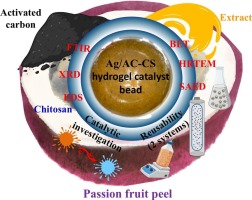
Comprehensive structural characterization using powder X-ray diffraction (XRD), Fourier-transform infrared spectroscopy (FTIR), scanning electron microscopy coupled with energy-dispersive X-ray spectroscopy (SEM–EDS), high-resolution transmission electron microscopy (HR-TEM), and selected area electron diffraction (SAED) confirmed uniformly dispersed AgNPs with an average particle size of 15.57 ± 3.64 nm and strong metal–support interactions. In the catalytic reduction of methyl orange (MO) using sodium borohydride (NaBH₄) as the reducing agent, the Ag/AC–CS catalyst achieved 97.35% dye removal within 30 min, with an apparent rate constant of k = 0.127 min⁻¹ under optimized conditions. Notably, continuous fixed-bed operation enabled sustained MO removal performance over five consecutive cycles, with superior stability and throughput compared to batch operation, accompanied by minimal Ag loss and preserved structural integrity. This integrated strategy combining green nanoparticle synthesis, biomass valorization, and a scalable fixed-bed configuration highlights Ag/AC–CS as a promising next-generation catalyst for sustainable and industrially relevant dye remediation.
https://www.sciencedirect.com/science/article/pii/S0144861726001438.
- Log in to post comments